How much does it cost to develop a SaaS application in Morocco?
The factors that determine the price of a SaaS application: scope, integrations, security, hosting and maintenance. Tips for budgeting your project.
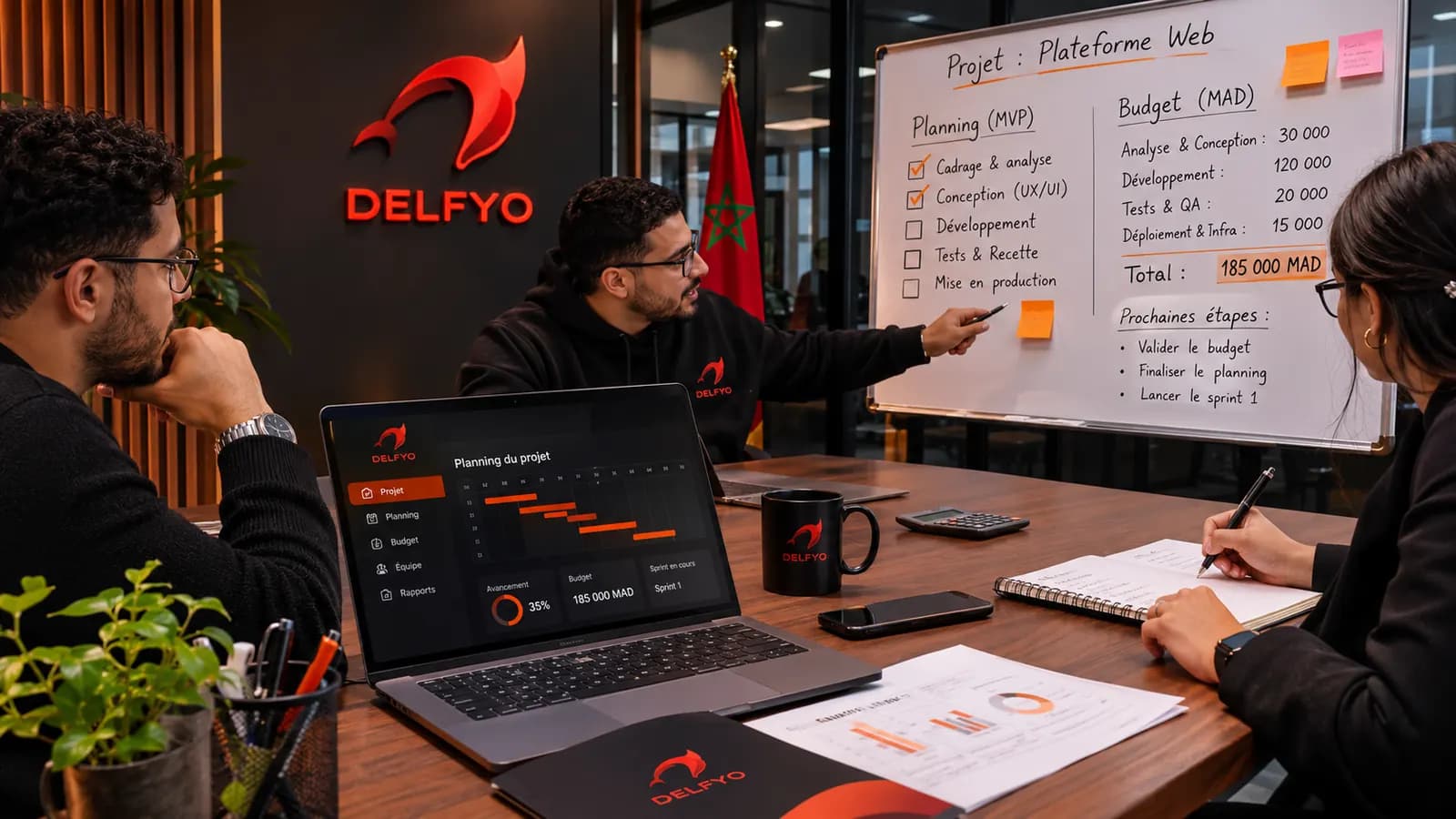
It is often the first question entrepreneurs and executives ask us when they want to launch a SaaS application: how much will it cost? The honest answer is that it depends, and a serious quote can only be drawn up once the project is understood. However, it is entirely possible to know what makes the price vary and how to keep your budget under control.
This article covers the main cost factors of a SaaS project, the items people often forget, and the approach we recommend to launch a product without taking unnecessary risks.
What determines the price of a SaaS application
1. The functional scope
This is the most important factor. The number of screens, user types (administrator, customer, team member…) and business rules has a direct impact on design, development and testing time.
An application that manages bookings with a simple dashboard is nothing like a platform that handles invoicing, inventory, team-based access rights and custom reports. Before talking about price, you need to list the features and, above all, prioritize them.
2. The multi-tenant model and subscriptions
A SaaS usually serves several client companies from the same application: this is called multi-tenancy. Each client's data must be isolated, accounts and teams must be managed, and several subscription plans are often offered.
Managing recurring payments (bank cards, direct debits, automatic invoices) also adds work, especially if you target customers both in Morocco and abroad with different payment methods.
3. Integrations with other tools
Your application may need to exchange data with an ERP, a CRM, accounting software, WhatsApp, an email platform or partner APIs. Each integration requires studying the third-party tool's documentation, handling errors and testing edge cases. A well-documented API integrates quickly; an older system without an API can take much more effort.
4. Design and user experience
A clear interface is a selling point for a SaaS: your future customers compare your product with others in a few minutes. The budget varies depending on whether you start from an existing component system or create a complete visual identity, with mockups tested with users.
5. Security and compliance
As soon as an application stores personal or sensitive data, security is not optional: strong authentication, encryption, fine-grained permissions, logging, backups. In Morocco, Law 09-08 governs the processing of personal data; if you have European customers, the GDPR also applies. These requirements must be taken into account from the design stage, because adding them later costs much more.
6. Scalability
An application intended for a few dozen users does not have the same needs as a platform that must support thousands of simultaneous connections. The architecture (databases, cache, message queues, containers) must be sized for your actual growth, without over-investing from the start.
The costs people often forget
Initial development is only part of the total budget. Also plan for:
- Cloud hosting: servers, databases, storage and bandwidth are billed every month by the provider (AWS, Azure, Google Cloud or another), and grow with the number of users.
- Third-party services: sending emails and text messages, payment gateway, monitoring tools, domain names and certificates.
- Maintenance: security updates for dependencies, bug fixes, compatibility with new browsers.
- New features: a SaaS evolves with its users. Their feedback will give rise to new features, which need to be budgeted for in the months after launch.
How to control your budget: start with an MVP
The best way to limit risk is not to build everything at once. We recommend starting with an MVP (Minimum Viable Product): a first version limited to the features that solve your customers' main problem.
This approach has several advantages:
- You put the product in the hands of real users sooner, which lets you check that it meets a real need before investing more.
- You prioritize based on concrete data rather than assumptions: the most requested features come first.
- You spread the investment over several stages, each with a clear goal.
In practice, good scoping means sorting each feature into three categories: essential for launch, useful later, and "idea to validate". Only the first category goes into the MVP.
Fixed price or time and materials: which billing model to choose?
Two billing models are common:
- Fixed price: a set price for a scope defined in advance. It gives budget visibility, but requires precise specifications; any change of scope requires an amendment.
- Time and materials: you pay for the time actually spent on the project. This model offers more flexibility to change priorities, provided you follow progress closely.
For a SaaS, a combination often works well: a fixed price for scoping and the MVP, then more flexible support for new features.
Questions to prepare before asking for a quote
To get a reliable estimate, prepare answers to these questions if possible:
- What problem does your application solve, and for whom?
- What are the three to five features essential for launch?
- How many users do you expect in the first year?
- Which tools must the application communicate with?
- Do you already have mockups, a visual identity or an existing application?
- What is your deadline, and why (trade show, fundraising, season)?
Even approximate answers make the first conversation much more productive.
In summary
The cost of a SaaS application depends above all on its scope, its integrations, its security requirements and its ability to scale, not forgetting hosting and maintenance after launch. The safest approach is to scope the need precisely, then launch an MVP before enriching the product based on your users' feedback.
Do you have a SaaS project? Explore our custom SaaS development offer or contact us to discuss it: we will help you define a realistic scope and estimate the corresponding budget.